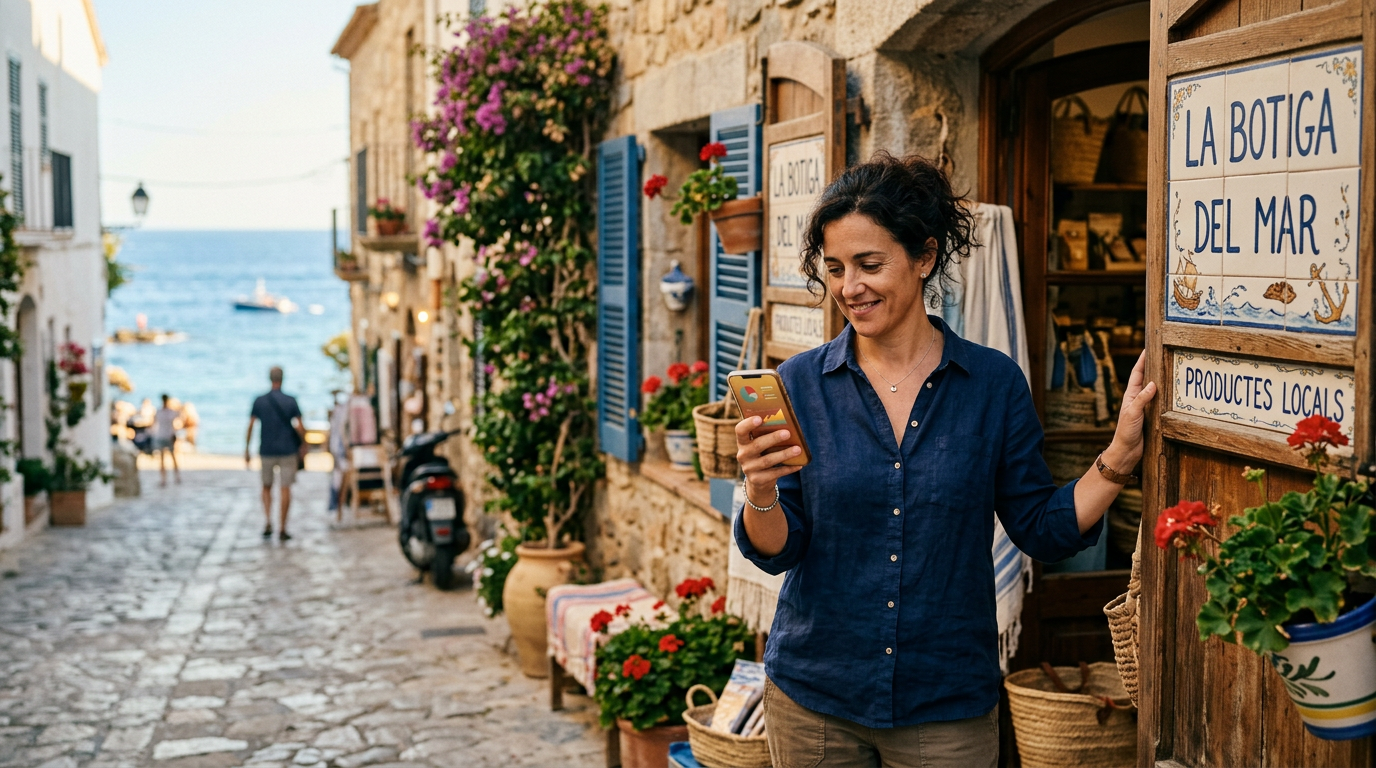


For a real estate agency in Jávea or a restaurant in the port of Alicante, the question isn't whether to be on Google, but how to capture traffic before the local competition does. In the saturated Costa Blanca market, choosing between organic positioning (SEO) or paid advertising (SEA) determines whether your marketing budget is an investment or simply a monthly expense without a clear return.
The winning strategy for 2026 consists of using SEA (Google Ads) to capture immediate purchase intent during tourist peaks, while local SEO builds sustained authority that reduces the cost per acquisition in the long term. In seasonal markets like the Valencian Community, relying on only one of them leaves openings that more agile competitors will exploit.
Key Points
What impact does AI (SGE) have on local SEO this 2026?
Google's artificial intelligence now answers user queries directly without them needing to click on a website. For a business in Denia or Altea, this means that the "Local Pack" (the Google map) and AI-generated responses are the new battleground.
To win in this environment, SEO is no longer just about keywords, but about Entities and Experience Signals. Google looks to verify that your business actually exists and is relevant. This is achieved through specific structured data markup (Schema.org) for local businesses and active management of reviews on Google Business Profile. In our 2025 audits, we detected that businesses with SGE-optimized profiles receive 40% more direct calls than those focusing only on traditional links.
Google Ads (SEA) on the Costa Blanca: Beyond the search engine
As of April 2026, SEA is no longer limited to text ads. With the consolidation of *Performance Max* and demand generation campaigns, SEA allows you to target tourists planning their trip to Benidorm or Moraira even before they search on Google.
The use of custom audiences based on location is critical. On the Costa Blanca, we can segment ads specifically for British or German expats residing here during the winter using their browser language. This avoids wasting budget on irrelevant clicks and ensures that every euro invested in paid advertising targets users with a higher Customer Lifetime Value (LTV).
Results Speed: The positioning "Gap"
One of the biggest differences between SEO and SEA is response time. SEO is an asset that grows with compound interest; at Apex Digital, we see that a local SEO project in the province of Alicante usually takes between 4 and 6 months to reach the first page for medium-difficulty terms.
In contrast, SEA is a tap: you turn it on and the traffic arrives today. For a new launch, such as a new build development in Calpe, waiting for SEO is a strategic error. SEA is needed to generate immediate *leads* while organic content matures. The key is balance: using SEA to test which keywords convert best before spending months trying to rank them organically.
The cost factor: VAT, competition, and profitability
In Spain, digital marketing must be analyzed through the lens of local profitability. With 21% VAT and growing competition in the service sector, SEO offers a superior long-term ROI because the organic cost per click is, technically, zero. However, technical maintenance and quality content creation require a monthly investment.
In 2026, the average CPC in the Costa Blanca real estate sector has risen by 15% compared to the previous year. This forces companies to be surgical with SEA. If your website conversion rate is low (less than 1%), you are giving money away to Google. This is where technical SEO — improving loading speed (Core Web Vitals) and user experience — directly helps make your SEA campaigns cheaper, as Google rewards the relevance of the ad destination.
From the field: what we see on the Costa Blanca
At the end of 2025, we worked with a group of restaurants in the port of Denia that relied exclusively on footfall and very generic Meta Ads campaigns. During the low season, their tables were empty even though searches for "charming restaurants in Denia" were still active.
We designed a hybrid strategy. First, we performed intensive local SEO: we optimized their Google profiles for multilingual searches (Spanish, English, and French) and corrected their contact data (NAP) across 15 local directories. Second, we activated SEA campaigns localized within a 10km radius, but only during critical booking hours (11:00 to 14:00 and 18:00 to 21:00).
The results were conclusive:
This case demonstrates that on the Costa Blanca, seasonality doesn't have to mean inactivity if your local SEO keeps you visible when the tourist is already at the destination, mobile in hand.
The Local Priority Framework (LPF)
To avoid getting lost in technicalities, at Apex Digital we apply the LPF framework to decide where to put our clients' money:
1. Fundamentals (SEO): If your website isn't fast and mobile-friendly, don't do SEA.
2. Immediate Capture (SEA): Use it for "emergency" services or high competition (e.g., locksmiths, lawyers, villa sales).
3. Authority (SEO): Create guides about life on the Costa Blanca (schools in Altea, taxes in Spain) to attract clients in the information phase.
4. Retargeting (SEA): Don't let a user who visited your site forget about you while they compare other options.
Executing this framework in 2026 requires real-time monitoring tools. A monthly PDF report is no longer enough; Google's AI changes the rules weekly.
SEO and SEA are no longer separate departments. If your ad data doesn't inform your content strategy, and your SEO Core Web Vitals don't optimize your SEA Quality Score, you are losing at least 30% of your marketing efficiency.
Digital success in Alicante and Valencia today depends on integration. Don't choose one; define how they will help each other under professional management.
Want to know which channel is more profitable for your specific sector today?
Related reading from Apex Digital
About the author
Apex Digital is a hands-on digital marketing agency based on the Costa Blanca, Spain, working with SMBs, hospitality, real estate and ecommerce brands across Alicante, Valencia and the wider region since 2020. Our focus is on measurable results and constant adaptation to Google algorithm changes.
Every article we publish is reviewed by a human strategist, verified with real data from our campaigns, and updated periodically when Google guidelines change to ensure maximum accuracy.
Need help applying this to your business? Book a free strategy call.
Free Website Audit Template
42-point checklist. Score your site.
Want us to implement this for you?
If you'd rather have experts handle your digital marketing strategy, we're here to help.
Book a Strategy Call