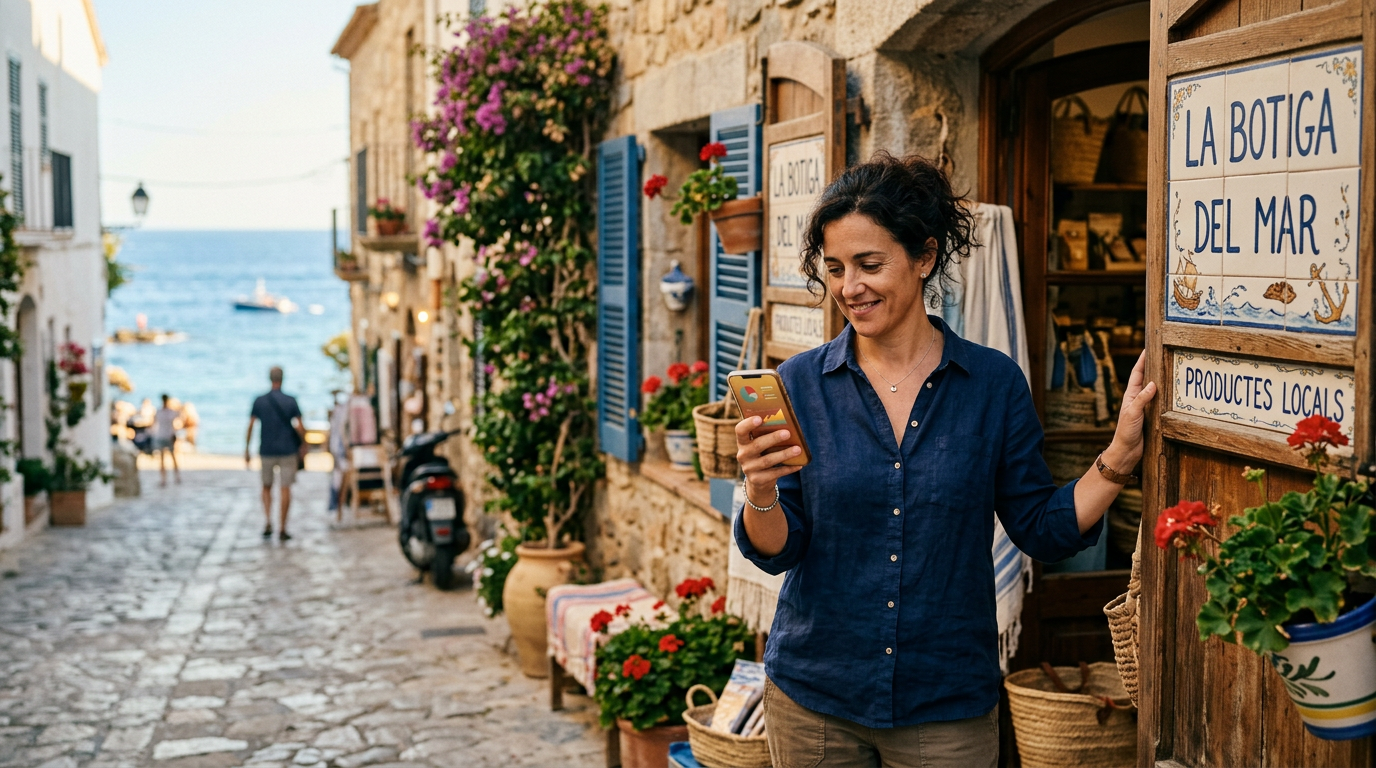


Attracting clients who speak your language while competing in the saturated Spanish market requires more than a literal translation; it demands a strategy of cultural and technical relevance. In 2026, success for companies founded by expats in Spain depends on how Google's algorithm interprets the hybrid search intent of a community that lives here but searches with the mindset of their country of origin.
SEO for expat businesses in Spain works when local authority is prioritized through Google Maps signals and specific geographical entities, combined with a content architecture that resolves Spanish legal and bureaucratic doubts (such as the NIE or VAT/IVA) in the client's native language. To dominate search results this year, it is essential to connect the technical infrastructure of the .es domain with semantics adapted to the jargon of the local foreign resident community.
Key Takeaways
Which domain to choose: .es, .com or .co.uk?
The choice of TLD (Top Level Domain) is the first critical step for an expat-led business. In 2026, Google gives significant weight to infrastructure geolocation. If your business physically operates on the Costa Blanca or in Valencia, the .es domain remains the strongest "trust anchor" for Google Spain.
Many foreign business owners make the mistake of keeping their original domains (like .co.uk or .de) thinking it helps them attract their compatriots. However, for local searches in Spain ("lawyers in Javea", "reforms in Altea"), Google prefers results that demonstrate a legal and physical presence within the national territory.
Google's algorithm now penalizes sites that do not comply with Spain's LSSI-CE regulations (the Information Society Services Act). Ensure that your .es domain has a legal notice and a cookie policy adapted to the AEPD to prevent the search engine from reducing your visibility due to lack of regulatory compliance.
The importance of "Expat-Friendly" semantics in content
Don't just translate words; translate concepts. A British expat on the Costa del Sol doesn't search for "asesoría fiscal", they search for "tax advice Spain" or "Spanish residency experts". The key to success in 2026 is the use of entities. Google no longer just reads keywords; it understands related concepts.
If your business is a *gestoría* in Alicante, your content must mention related entities such as "TIE", "Modelo 720", "Alicante Town Hall", and "Digital Nomad Visa". This semantic proximity tells Google that you are an expert in the specific expat niche. Additionally, using Spanish terms mixed with the primary language (e.g., "Paying your IBI tax") helps position for searches that foreign residents already perform using local terms.
Google Maps and proximity SEO in tourist areas
For a brick-and-mortar business in Calpe or Moraira, your Google Business Profile (formerly Google My Business) is more valuable than your own website. Google is prioritizing "near me" results even when the search is performed in English or German.
To stand out, it is vital that your profile includes:
1. Bilingual reviews: Encourage both your Spanish and foreign clients to leave reviews. A profile with reviews in multiple languages tells Google it is a business capable of serving a diverse audience.
2. Service attributes: Explicitly check "English spoken" or "Multilingual service" in your profile settings.
3. Geolocated photos: Upload images of your office or premises with location metadata active. Google uses computer vision to confirm your business is actually where you say it is.
Multilingual SEO: Technical structure for 2026
Avoid using automatic translation tools like "flag plugins" that do not generate indexable URLs. Google 2026 ignores content hidden behind layers of translation JavaScript. The structure recommended by Apex Digital to maximize SEO is the use of subdirectories.
Example: `yourweb.es/en/` for English and `yourweb.es/de/` for German. Each version must have its own `hreflang` tags correctly configured in the `<head>`. This prevents duplicate content issues and allows each page to index independently for queries in its respective language.
Don't forget that even if the content is in English, the structured data (Schema.org) must reflect that the location is Spain, using the `addressRegion` field with the corresponding province (for example: Alicante).
The "Trust-First" framework for real estate and legal businesses
In the expat sector of the Costa Blanca, competition is fierce, especially in real estate and legal services. To win, we apply the "Trust-First" framework: prioritizing trust signals over keyword optimization.
This includes displaying local certifications (such as the Valencian Community real estate agent registry), including the business CIF (tax ID) in the footer, and having a "Team" section with real photos and links to LinkedIn profiles. Google uses these E-E-A-T (Experience, Expertise, Authoritativeness, and Trustworthiness) signals to rank websites that handle "Your Money or Your Life" (YMYL) topics, such as legal or investment services.
From the field: what we see on the Costa Blanca
We recently worked with a boutique real estate agency in Moraira specializing in Northern European clients. Despite having luxury properties, their web traffic was residual, and they relied entirely on portals like Idealista or Kyero. When auditing their site, we discovered that 90% of their content was English auto-translated into Spanish with severe grammatical errors, and their Google Maps profile pointed to an old address in Benidorm.
We implemented a three-phase strategy:
1. Technical Cleanup: We migrated their subdomain structure (`en.agency.com`) to subdirectories under a new `.es` domain and corrected the hreflang tags.
2. Content Localization: We created guides on "Living in Moraira: Costs, Schools, and Healthcare" in English, German, and Spanish, optimized for "lifestyle" queries that their competitors were ignoring.
3. Local Authority: We ran a geolocated review capture campaign, asking their clients to mention the specific neighborhood (El Portet, San Jaime) in their comments.
The result: In just 16 weeks, organic traffic from German search engines grew by 145%. More importantly, the cost per lead dropped by 30% as the incoming traffic was much more qualified. Today, they appear in the Google "Map Pack" for 80% of searches for luxury properties in Moraira, competing head-to-head with much larger international franchises.
Information Gain Framework: The Local Adaptation Indicator (LAI)
At Apex Digital, we use a proprietary concept called the Local Adaptation Indicator (LAI). Unlike traditional SEO that only looks at search volumes, the LAI measures how many local Spanish entities (street names, local festivals, regional regulations) appear in your foreign-language content.
In 2026, Google detects if content has been written by someone who "knows the ground" or by a generic generative AI. An article about "Buying a house in Javea" that specifically mentions the *actos jurídicos documentados* tax (AJD) and proximity to the Montgó will have a much higher LAI—and therefore higher priority in rankings—than a generic text of "5 tips to buy in Spain".
Conclusion
SEO for expats in Spain is no longer a matter of language, but of geographical authority and technical precision under the .es domain.
Next step: Review your Google Business Profile and verify if your Spanish address and phone number match exactly what appears in the footer of your website.
Related reading from Apex Digital
About the author
Apex Digital is a hands-on digital marketing agency based on the Costa Blanca, Spain, working with SMBs, hospitality, real estate and ecommerce brands across Alicante, Valencia and the wider region since 2020. Our team combines the strategic vision of local experts with a deep understanding of the behavior of international consumers residing or investing in Spain.
Our editorial standards ensure that every article is reviewed by a human strategist, verified with real Spanish market data, and updated as Google's guidelines evolve.
Need help applying this to your business? Book a free strategy call.
Free Website Audit Template
42-point checklist. Score your site.
Want us to implement this for you?
If you'd rather have experts handle your digital marketing strategy, we're here to help.
Book a Strategy Call